How Much Should You Tip On A Ghost Tour?
Honest tipping ranges for Boston ghost tours, with worked examples from real tour prices, cash versus app advice, and when a smaller tip is fair.
How Much Should You Tip On A Ghost Tour?
A good working rule for a United States guided walking tour is $5 to $10 per person for a solid outing, or roughly 15 to 20 percent of the ticket price if the tour wowed you. On a pricier product like a 2-hour trolley tour from $46, most travelers land around $8 to $15 per person. If the guide was dull, rushed, or read from a script, a smaller tip or none at all is a fair response. Tipping is a judgment call, not a tax.
That is the short version. The longer version depends on what you actually booked, because a 1-hour walk and a 2.5-hour pub crawl are different jobs, and the tip should reflect the difference. On many U.S. guided tours, including Boston ghost walks, guides often earn a modest base plus tips, as is common across the guided-tour trade, so the tip is not a bonus on top of a healthy wage. It is a real part of the guide's income, and every operator on the Boston roster implicitly builds it into their economics.
Start with the ticket itself, since the tip is easiest to calculate as a share of it. The five walking tours on the Boston roster run from $22 to $35. The single trolley product, the 2-Hour Ghosts and Gravestones Trolley, runs from $46 and is by far the most-reviewed tour on the roster at 4.5 across 2,645 reviews. The three haunted pub crawls, all 21 and over, run from $29 to $36. A $5 bill on a $26 ticket is a nearly 20 percent tip. The same $5 on a $46 trolley ticket is closer to 11 percent, so the trolley deserves a slightly bigger note.
If you want the three best-value picks on the roster for keeping your total night-out cost, tip included, low, these are the ones worth comparing first.
For a concrete floor, look at the cheapest ticket in the city. The 1-Hour Underground Ghost Walk, run under the US Ghost Adventures banner, starts at $26 and carries a 4.0 rating across 274 reviews. It meets at 139 Tremont Street, at the Boston Common Visitors Center across from the Dunkin'. One hour of guided storytelling for $26 means a $5 tip per person takes your total to $31, and a $10 tip takes it to $36, which is still less than most competing tickets before tipping. For budget travelers this is the walk where generous tipping hurts least, and the guide still ends up with a meaningful thank-you.
There is one more framing worth settling before the details. A tip is a rating you pay for. A five-star review costs you two minutes and helps the guide's standing; a fair tip pays their rent. The best practice, and the one most guides will tell you they appreciate most, is both: cash in hand at the farewell, and a written review on the live listing that night while the details are fresh.
How Does Tipping Differ Between Walking Tours And The Trolley?
Walking tours are tipped per person, in cash, at the end of the walk, usually $5 to $10 each. The trolley is different in scale: a 2-hour ride from $46 with a driver and often a separate onboard guide means common practice runs $8 to $15 per person, and families frequently hand one larger note rather than fuss with per-head math. The mechanics of the tour shape the tip.
The 2-Hour Ghosts and Gravestones Trolley, operated by Historic Tours of America, is the heavyweight of the Boston lineup. It meets at 200 Atlantic Avenue, the Old Town trolley stop at the end of the Marriott Long Wharf Hotel, and its 2,645 reviews dwarf every other product on the roster. The operator's own history page records the Ghosts and Gravestones frightseeing format running since 1998, which makes it one of the oldest formal ghost tourism products in the country. On a vehicle tour the crew cannot linger with each guest, the group is bigger, and the tour covers ground a walker could not cover in two hours, including burying ground stops the walking routes do not reach.
On the walking side, the busiest comparably scaled product is the 1.5-Hour Night-Time Ghost Walk from Ghost City Tours, from $30 at 4.5 across 313 reviews, the most-reviewed walking tour on the roster. It meets at 58 Tremont Street, outside King's Chapel Burying Ground, and its ticket price sits right at the center of the walking range, which makes it the cleanest reference point for the standard $5 to $10 walking tip. A couple handing the guide a folded ten at the burying ground gate has done the arithmetic exactly right.
| Tour format | Typical ticket | Common tip range, per person | Notes |
|---|---|---|---|
| 1-hour ghost walk | $26 | $4 to $8 | Short format, one guide, tip at the closing stop |
| 1.5-hour ghost walk | $22 to $35 | $5 to $10 | The standard Boston walking format |
| 2-hour trolley tour | $46 | $8 to $15 | Driver and guide both work the tour; a single larger note per couple is common |
| 2-hour pub crawl | $29 to $36 | $5 to $10 plus the bar tab | Drinks are billed separately and always are |
These ranges are ordinary United States guided-tour norms, not promises from any operator. No Boston operator publishes a required tip, and none of the listings on the roster describes tipping as mandatory. Treat the table as a planning allowance: bring the cash, expect the middle of the range, and spend the top of it only when the guide earned it.
One practical difference between the formats is timing. A walk ends where the guide finishes the last story, on a street corner or a cemetery gate, and the guide is standing right there for the goodbye. That is your moment. The trolley returns to a stop near where you boarded, and the crew is usually busy unloading the next batch of riders, so trolley tips are best handed over as you step down, not after you have already walked away toward dinner.
How Much Should You Tip On A Haunted Pub Crawl?
The standard is $5 to $10 per person on top of the crawl ticket, from $29 to $36, plus whatever you spend on drinks. Your bar tab is separate and always will be: crawl tickets buy the guide and the route, not the beer. If the guide steered the group to good pours and kept a mixed crowd talking for two-plus hours, the upper end of the range is the honest choice.
Boston has three crawls on the roster, and they are easy to confuse, so here is the clean breakdown. The 2-Hour Boos and Brews Crawl, from US Ghost Adventures, runs from $29 with a 4.5 rating across 123 reviews, meeting at 139 Tremont Street. The Historic Pubs and Taverns Crawl, from Ghost City Tours, runs from $35 with a 4.4 rating across 149 reviews, meeting at the Samuel Adams Statue. The 2.5-Hour Booze and Boos Crawl, from Nightly Spirits, runs from $36 with a 4.5 rating across 162 reviews, meeting at The Last Hurrah inside the Omni Parker House at 60 School Street. Three different operators, three different prices, three different starting points, and never one merged product despite the similar names.
Tipping logic on a crawl differs from a walk in one way: the guide is also doing crowd management in venues that do not belong to them. They are coordinating with bartenders, keeping a moving group of strangers together, and performing history over the noise of a busy bar. That is harder work than a quiet cemetery stroll, and the tip ranges people actually use reflect it. A common approach is to hand the guide cash at the final stop, and, if a bartender poured especially well at one stop, to tip that bartender well on your own tab.
A worked set of examples, using real roster prices and rounded to whole dollars, makes the math concrete:
| Tour | Ticket | 15 percent tip | 20 percent tip | Night-out total at 20 percent |
|---|---|---|---|---|
| 1-Hour Underground Ghost Walk | $26 | $4 | $5 | $31 |
| 1.5-Hour Night-Time Ghost Walk | $30 | $5 | $6 | $36 |
| Historic Pubs and Taverns Crawl | $35 | $5 | $7 | $42 before drinks |
| 2.5-Hour Booze and Boos Crawl | $36 | $5 | $7 | Ticket plus a $7 tip, before drinks |
| 2-Hour Ghosts and Gravestones Trolley | $46 | $7 | $9 | $55 |
Rounding is fine. Nobody has ever been judged for handing a guide $10 on a $30 ticket instead of $6. In the other direction, three friends pooling a single $5 bill on a group of three full-price tickets is the kind of arithmetic guides notice and quietly remember.
When Is It Okay To Tip Less, Or Skip The Tip Entirely?
Tipping less is fair when the guide was late, rushed the route, got facts visibly wrong, or phoned in a script with no enthusiasm. Skipping the tip entirely is a reasonable response to a no-show, a tour cut dramatically short, or a guide who was dismissive or inappropriate. In those cases a written review describing what happened is worth more to future guests than cash.
The strongest consumer protection on this roster is that every product except one carries free cancellation on the listing. If a tour looks wrong before it starts, you can usually cancel without losing the ticket, which removes most of the situations where resentment, and stingy tipping, would otherwise build. The one exception is the 1.5-Mile Haunted Streets Walk from ExperienceFirst, which lists at 5.0 across 49 reviews and from $34, but is the single listing on the roster without free cancellation. Book that one only when your evening is certain, and if you do take it and the guide delivers, the tip is simply the normal $5 to $10.
A few honest in-between cases come up constantly. Weather is the big one: a guide who runs a full tour through rain or cold has worked harder, not less, and most regulars tip at the top of the range for it. Group size cuts the other way. A guide shepherding twenty people through the Granary Burying Ground is doing a bigger job than one leading four, but per-person tips already scale with headcount, so you do not owe extra on top of your own $5 to $10. And if you booked with a discount, tip on what the tour is worth, not on what you paid. The guide did not discount their work.
One habit worth copying from experienced guests: decide your tip at the midpoint of the tour, not at the end. If the first half was strong, commit to the higher number early and just enjoy the second half. It removes the end-of-tour mental bargaining, which is the least fun part of any night out, and it means you are not fumbling for an amount while twenty people say goodbye on a sidewalk.
Should You Tip In Cash Or Through The App?
Cash, handed directly to the guide, is still the gold standard on ghost tours. Some operators offer app-based or card-based tipping at checkout or on the listing, and those work, but a physical bill at the farewell is instant, fee-light, and unambiguous. If you booked a tour with a solo guide and no shopfront, bring paper money.
The practical reason is simple. Walking tours end on street corners, and the 1.5-Mile Haunted Streets Walk meeting point at the Robert Gould Shaw and the 54th Regiment Memorial on Boston Common has no counter, no card reader, and nowhere to queue. Pub crawls end inside the last bar, where a card tip can get tangled with the bar's own systems. The trolley ends at a stop on Atlantic Avenue with a boarding crowd behind you. In all three cases, cash solves the transaction in three seconds.
There is a secondary argument for cash that regulars often raise: it is the surest path from your hand to the guide's pocket. App and platform tips are generally passed through, but they can be batched, delayed, or split by house rules the guest never sees. A folded bill has no such ambiguity. For the amount involved, five to ten dollars per person, cash also feels like what it is meant to feel like, a direct thank-you, rather than one more line on a receipt.
If you genuinely never carry cash, say so to the guide at the start rather than at the end. Most guides can produce a QR code or a name to search in a payment app, and being upfront buys goodwill that a surprise at the farewell does not. Guides have seen every version of "I'll catch you on Venmo" and most are gracious about it, but the ones who hear it at the beginning, from someone who then does it, are the ones who remember the guest kindly.
Do You Tip Per Person Or Per Group?
Both conventions exist, and both are fine. Per person, $5 to $10 each, is the default on walking tours. Per group works when you are one party traveling together: couples commonly hand a single $10 or $20 note, and a family of four on a trolley might hand one larger bill as a single payment. The only real rule is that the total should match what the individuals would have given.
The group math is worth spelling out because it is where people accidentally under-tip. Two people on the 1.5-Hour Night-Time Ghost Walk at $30 each should be aiming at a combined $10 to $15, not a combined $5. A bachelorette party of eight that hands the pub crawl guide one $20 note has tipped well under the per-head range on a two-hour outing, a fraction of what the same eight guests would have handed over individually. If you are the person organizing the group, do the per-head multiplication before the tour, not after.
| Your party | Walking tour, sensible total | Trolley, sensible total | Easy way to carry it |
|---|---|---|---|
| Solo traveler | $5 to $10 | $8 to $15 | Two fives and a ten |
| Couple | $10 to $20 | $15 to $25 | A twenty plus a ten |
| Family of four | $20 to $40 | $30 to $50 | Twenties and a handful of fives |
| Group of eight | $40 to $80 | $60 to $90 at the top of the range | One designated tipper holding the cash |
Children count, at a discount. A family of four with two kids on the Common And Beacon Hill Route, which lists 5.0 across 12 reviews from $22, does not need to hit the full adult per-head number for the kids, but the guide still narrated to the whole family for the full ninety minutes. Most parents land at half-rate for children under about twelve, which tracks with how the operators themselves price some family tickets.
One edge case: private and corporate bookings. None of the standard roster products is a private tour by default, but if you arrange a private group version with an operator directly, tipping norms shift upward, commonly 15 to 20 percent of the whole booking, because the guide has dedicated the entire slot to your party. Agree the amount with the organizer in advance so the guide is not left to guess.
What Do Ghost Tour Guides Actually Earn, And Why The Tip Matters?
Ghost tour guides in the United States typically earn a modest hourly base, often at or near the local service wage, with tips treated as a core part of take-home pay rather than a bonus. Boston's guides are no exception, and the city's cost of living makes the tip share of income matter more here than in cheaper markets. A $26 ticket does not flow to the person telling the story.
The industry structure explains why. Boston's organized ghost tourism is old enough to have generations of guides: the Ghosts and Gravestones trolley format dates to 1998, Haunted Boston Ghost Tours has been walking since 2005, and Ghost City Tours began its Boston operations in 2012. Across that whole span, the business model has been the same one restaurants use, a modest base plus gratuities, because it lets operators keep list prices competitive while recruiting performers who are good enough to earn the tip. The five-star ratings on the roster, like the 5.0 across 49 reviews on the Haunted Streets Walk or the 5.0 across 12 on the Common And Beacon Hill Route, are earned by people whose pay partially depends on your last two minutes with them.
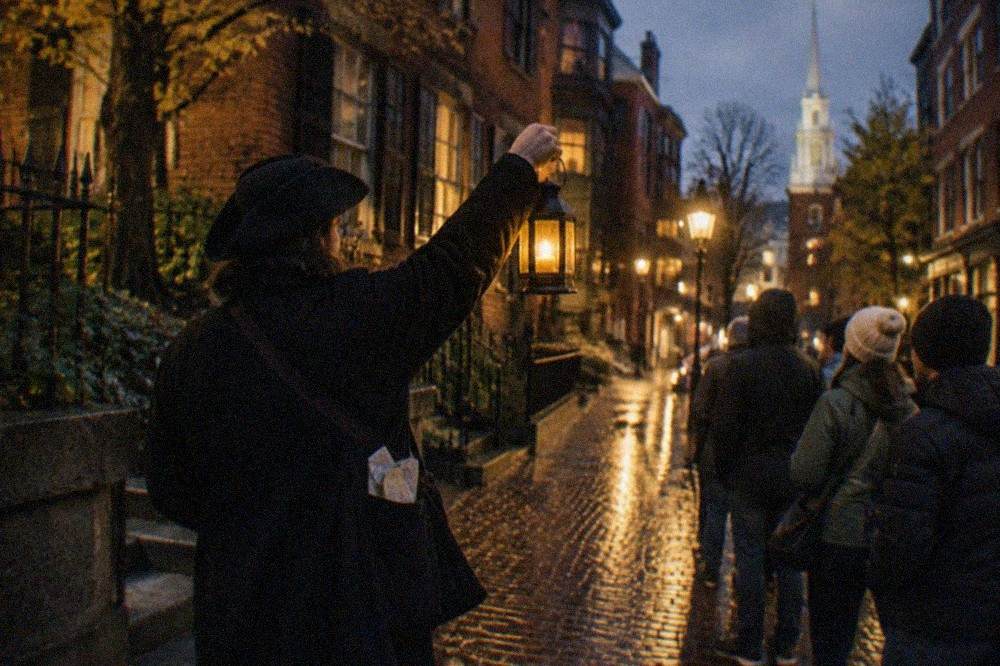
There is also a fairness angle specific to this trade. A good ghost guide is doing three jobs at once: historian, comedian, and crowd controller, at night, in weather, on uneven ground. The Granary Burying Ground alone holds an estimated 5,000-plus burials under roughly 2,345 surviving stones, per the city's own cemetery page, and a guide is expected to make that density of history land with a tired family at 9 p.m. The city's Granary Burying Ground page keeps the official hours and rules, and guides who respect them, closing time, no grave rubbing, stay on paths, are doing quiet work nobody tips them for.
This is also the context for the standard advice that the tip belongs to the guide, not the company. Handing it to the person directly, rather than leaving it on a counter or assuming the ticket price covered it, is the whole point. If two guides worked your tour, as happens on the trolley and sometimes on large crawls, split it or double the low end, do not make the crew divide a single bill.
How Does Boston Compare With Other Cities For Ghost Tour Tipping?
Boston norms match general United States guided-tour practice: $5 to $10 per person on a standard walking tour, scaled up for longer or vehicle-based products. Nothing about Boston's ghost tour market makes it an outlier, and its ticket prices, $22 to $46 across the roster, sit in the middle of what comparable historic cities charge for the same format.
Where Boston is unusual is density, not price. The walking routes on the roster overlap heavily with the official Freedom Trail, a 2.5-mile route linking 16 nationally significant sites, which means a guest can stand on one corner and be within sight of the Granary, King's Chapel Burying Ground, the Central Burying Ground and the State House all at once. Guides compress a lot of verified history into a short walk, and the tours that do it best, like the Death-And-Dying Theme Ghost Walk at 4.5 across 230 reviews from $35, are selling curation, not mileage. Tip accordingly: you are paying for the selection and the storytelling, not the steps.
Visitors coming from Salem often ask whether the same rules apply there. They do. A guided walk is a guided walk, and the Salem operators run the same base-plus-tips model. If you are planning a Salem add-on, the practical tip is the same $5 to $10 per person in cash, and the practical warning is crowd scale: Destination Salem counted 1.1 million unique October visitors in 2025 and 96,000 on Halloween Day itself, so Salem guides in October are working the hardest gigs in the region, usually for the largest groups (see Salem at Halloween). Planning that pairing is covered in detail in Boston Ghost Tours' own Salem day trip guide, and the broader safety question for walking Boston's downtown at night is answered in the site's piece on walking Boston at night safely.
For choosing the right tour in the first place, which changes the tipping conversation more than any range does, the site's comparison of the best ghost tours in Boston breaks the whole roster down by format, price and review depth. A well-matched booking tips naturally. A mismatched one, a family with tired kids on a 2.5-hour crawl, for instance, tends to end in a stiff goodbye no matter how good the guide was.
Whichever of the three flagship formats you land on, the cheap underground walk, the well-reviewed night-time walk, or the big trolley, the tipping plan does not change: cash in hand, per head, handed to the guide at the farewell. Here is the full trio one last time, prices and review counts included, so the tip math is the only arithmetic left to do on the night.
Common Questions About Ghost Tour Tipping
How Much Should You Tip On A Ghost Tour?
Plan on $5 to $10 per person for a standard walking ghost tour, or roughly 15 to 20 percent of the ticket price for an outstanding one. On a longer or vehicle-based product, like the 2-hour trolley from $46, $8 to $15 per person is the common range. Bring cash and hand it to the guide directly at the end.
Is Tipping Required On Boston Ghost Tours?
No. No operator on the Boston roster publishes a required tip, and tipping is a voluntary thank-you for the guide's work. It is also genuinely expected in the sense that guides are paid on a base-plus-gratuity model, so a good outing without any tip reads as a poor review in cash form.
Can You Tip A Ghost Tour Guide With A Card Or An App?
Usually yes, if you ask. Some listings and operators offer app-based tipping, and many guides carry a QR code or accept payment-app transfers. Cash is still preferred because it is instant and goes straight to the guide, so if you plan to tip digitally, tell the guide at the start of the tour rather than at the farewell.
Do You Tip The Same On A Haunted Pub Crawl?
Yes, $5 to $10 per person on top of the ticket, from $29 to $36 on the Boston roster. Your drinks are always billed separately by the bars themselves, so budget the tip and the bar tab as two different numbers. A bartender who poured well gets tipped on your tab as usual.
What If The Guide Was Bad, Late, Or Rude?
Tip less, or nothing, and say why in a written review on the live listing. A tip is a rating you pay for, and a guide who was late, rushed the route, or dismissive has not earned the standard range. A factual review helps future guests more than a resentful five dollars.
Do You Tip Per Person Or Give One Group Tip?
Both work. Per person at $5 to $10 each is the default, but a couple handing one $10 or $20 note, or a family handing a single larger bill on the trolley, is completely normal. The only rule is that the group total should roughly match what the individuals would have given, so do the per-head math before the tour, not after.