Boston Ghost Walking Tour Vs Trolley: Which To Book
Five walking tours and one trolley. Here is how the two ghost-tour formats in Boston actually differ on price, pace, duration and stops, and which one deserves your booking.
Short answer
The Death-And-Dying Theme Ghost Walk costs from $35, rates 4.5 from 230 reviews, and tells its stories on foot among the burying grounds. The 2-Hour Ghosts and Gravestones Trolley costs from $46, rates 4.5 from 2,645 reviews, and covers more ground seated over two hours. Budget, stamina and how much history you want per stop decide it.
Boston's ghost-tour market splits into exactly two formats: on-foot walks that thread the colonial burying grounds, and a single trolley product that rolls between them. The roster makes the choice concrete. Five walking tours run from $22 to $35 for one to one-and-a-half hours, while the 2-Hour Ghosts and Gravestones Trolley runs from $46 for two hours and carries 4.5 across 2,645 reviews, by far the deepest review pool of the nine products listed on this site. That asymmetry, many walks, one trolley, is the whole decision.
This page is deliberately narrow. It puts one representative walking product, the Death-And-Dying Theme Ghost Walk, head to head with the one trolley, on the numbers that matter: price, duration, intensity, route and audience. For the full nine-tour ranking across every format, including the pub crawls, read our best Boston ghost tour comparison. For a deeper dive on the trolley product alone, see our Ghosts and Gravestones trolley guide.
Walking Tour Or Trolley: Which Format Fits Your Evening?
A Boston ghost walk wins on price, intimacy and graveyard time: the Death-And-Dying Theme Ghost Walk runs from $35 for a themed, on-foot telling at burial sites. The 2-Hour Ghosts and Gravestones Trolley costs from $46, covers more ground while seated, and carries 4.5 across 2,645 reviews, the largest review pool on the roster. Your pace, budget and stamina decide it.
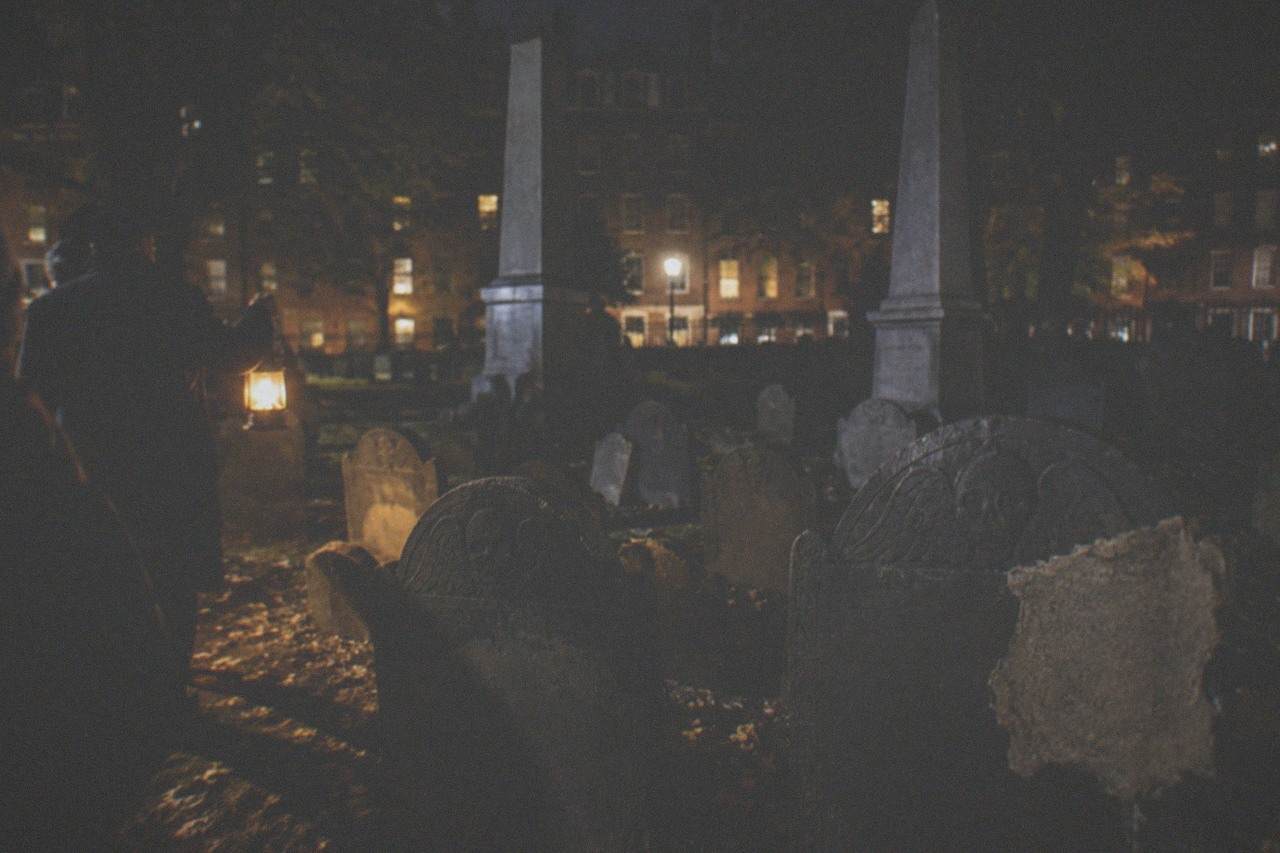
The formats solve different problems. A walking tour is a slow, close-range experience: you stand inside the burying grounds, your guide is an arm's length away, and the stories land where the bodies actually lie. The trolley is a moving theater: you ride between stops, you cover neighborhoods a walker could never reach in two hours, and you get off at a handful of highlight locations.
Neither format is objectively better, and the roster's ratings say as much. The trolley's 4.5 from 2,645 reviews reflects a mass-market product polished over decades. The walking products cluster at 4.0 to 5.0 from much smaller pools, which tells you they are niche bookings that their guests tend to rate highly, not that they outsell the trolley.
| Format | Cheapest roster option | Typical duration | What you trade |
|---|---|---|---|
| Walking ghost tour | From $22 (1.5 hours) | 1 to 1.5 hours on foot | Ground covered for depth per stop |
| Ghost trolley tour | From $46 (2 hours) | 2 hours, mostly seated | Intimacy for reach and comfort |
One honest framing note before the numbers: readers who want the widest possible field, including the three haunted pub crawls and all five walks ranked together, should treat this page as a complement to the full roster guide, not a replacement for it. This is the two-way decision, for the reader who has already narrowed it to feet versus wheels.
What Does The Walking Tour Give You For The Money?
The walking side of the comparison centers on the Death-And-Dying Theme Ghost Walk: from $35, rated 4.5 from 230 reviews, meeting at 24 Beacon Street in front of the Massachusetts State House, with free cancellation on the listing. Its duration is not recorded on the roster, so treat that as a live-listing detail. Cheaper walks exist, but this is the strongest themed representative.
The "Death-And-Dying Theme Ghost Walk" earns its place in this comparison because it is the most format-defining walk on the roster. Its whole premise is how Bostonans died: epidemics, executions, burial customs and the overcrowding that gave the city four colonial burying grounds within a mile of each other. That is a story you can only tell standing at the sites, which is precisely the walking format's advantage.
For contrast inside the same format, the cheapest walk on the roster is the "1-Hour Underground Ghost Walk" from US Ghost Adventures: from $26, rated 4.0 from 274 reviews, one hour, meeting at 139 Tremont Street outside the Boston Common Visitors Center. It trades the themed depth of the death-and-dying walk for a shorter, cheaper, more family-friendly hour. The two products make the walking format's range visible: $26 for a quick hour, $35 for the themed deep cut.
Every product on the roster except one walking listing carries free cancellation, and the death-and-dying walk is on the covered side of that line, so a weather-driven change of plan costs nothing but a few minutes.
| Tour | Format | Price from | Rating and reviews | Meeting point |
|---|---|---|---|---|
| Death-And-Dying Theme Ghost Walk | Walking | $35 | 4.5 from 230 reviews | 24 Beacon St, State House |
| 1-Hour Underground Ghost Walk | Walking | $26 | 4.0 from 274 reviews | 139 Tremont St, Boston Common |
| 2-Hour Ghosts and Gravestones Trolley | Trolley | $46 | 4.5 from 2,645 reviews | 200 Atlantic Ave, Long Wharf |
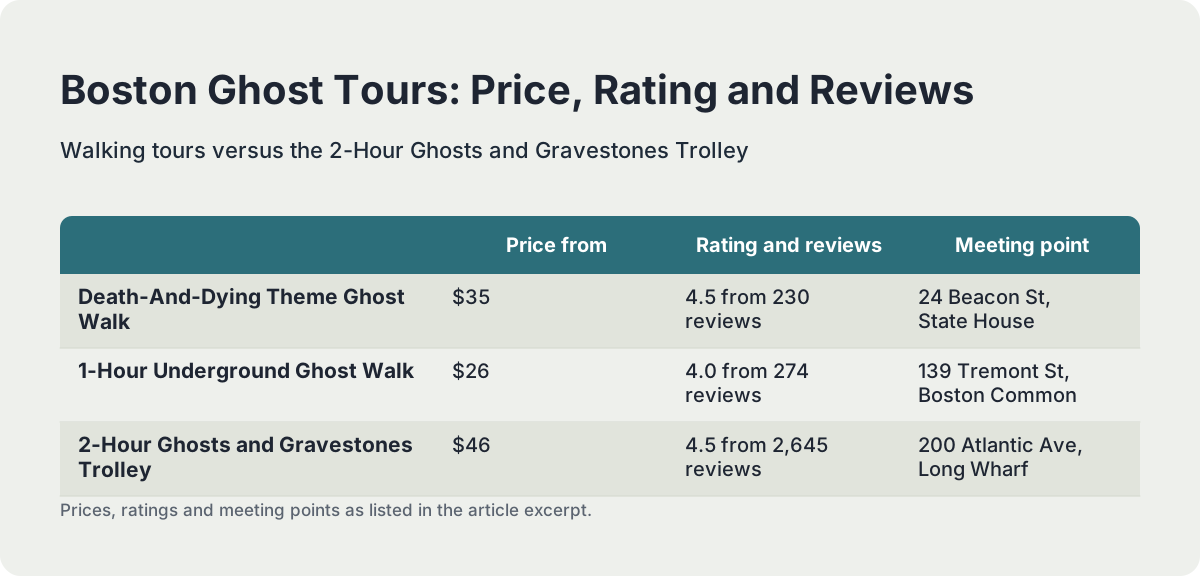
Price, then, is not really the deciding variable between the formats. Eleven dollars separates the themed walk from the trolley, which is negligible against a Boston dinner. What actually separates them is what the next two sections cover: what the trolley gives you for its premium, and what each format physically asks of you.
What Does The Ghosts And Gravestones Trolley Give You?
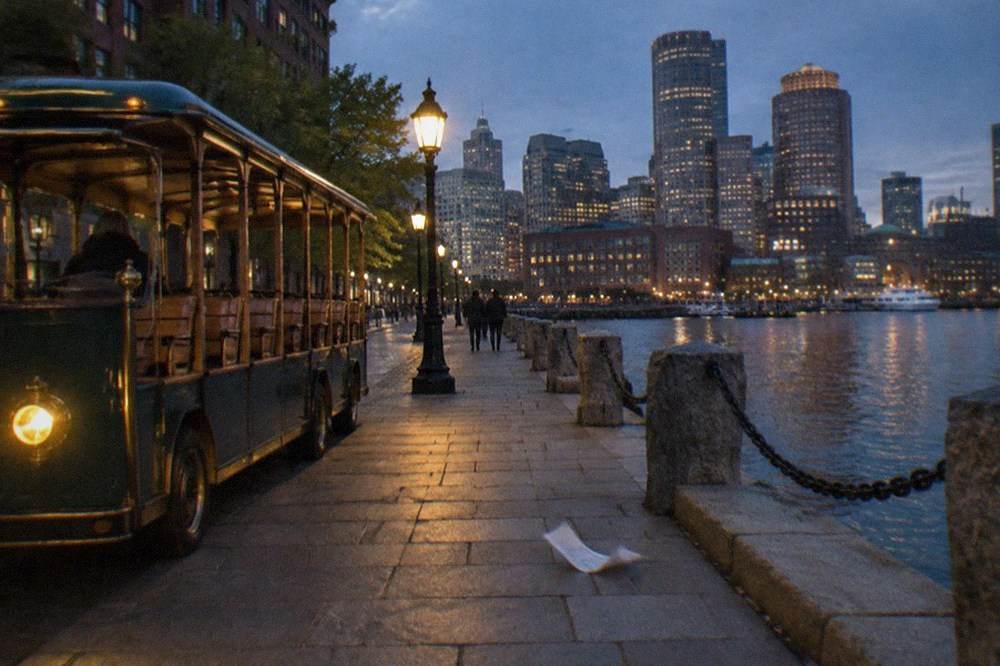
The 2-Hour Ghosts and Gravestones Trolley, run by Historic Tours of America, costs from $46 for two hours and rates 4.5 across 2,645 reviews, the most-reviewed product on this roster by a wide margin. It departs from 200 Atlantic Avenue at the Old Town Trolley stop by Long Wharf, and its listing carries free cancellation. Its scale is the point.
The trolley's review pool is not just the largest on this site, it is roughly five times the combined pool of the two walks in this comparison. That is what two decades of operation looks like: the Ghosts and Gravestones concept dates to 1998, when Historic Tours of America launched it as one of the earliest formalized ghost-tour products in the city, and the operator's own history page records that lineage. A product that has run continuously since the late nineties has had a lot of evenings to refine its script.
What the premium buys is coverage. A walker covers perhaps a mile of downtown in ninety minutes; the trolley crosses multiple neighborhoods in two hours, with off-board stops at signature sites. Operator marketing for the tour leans on access to burying grounds after dark, a claim worth treating as the operator's own narrative rather than a guaranteed privilege, but the structure itself is real: you ride, you disembark, you ride again. For visitors whose legs or schedule cannot absorb a long walk, that structure is the entire value proposition.
The trade is intimacy. On the trolley you experience the stories at one remove, through a narrator and a window, with a larger group. On the walk you are standing in King's Chapel Burying Ground when the guide tells you what is under your feet. Neither is a gimmick; they are genuinely different products that happen to share a subject.
Which Format Suits First-Time Visitors To Boston?
First-time visitors with one free evening and no mobility constraints should book the walking format first, because a themed walk like the Death-And-Dying Theme Ghost Walk anchors the history to specific sites you will re-encounter all week. Visitors who are tired, cold, or short on time should take the trolley, which delivers the city's haunted greatest hits seated, in two hours, from $46.
The logic is about repetition. Boston's historic core is small, and everything a walking tour shows you, the State House, the burying grounds, the Common, is space you will cross again on museum days and restaurant nights. The walk trains your eye. A first-timer who has heard the Granary's story at night recognizes the graveyard two days later from the opposite direction.
The trolley is the better first product for a different first-timer: the one arriving on a red-eye, the one with a knee that objects to cobblestones, the one shepherding a group that will not hold a walking pace for ninety minutes. Covering more ground means more names, more neighborhoods and more orientation per hour, and two hours seated beats ninety minutes standing when energy is the constraint.
If this decision is really about evening energy rather than format, it may be worth checking whether a crawl suits you better than either: our ghost tour versus pub crawl comparison covers that third format in the same style.
The one wrong answer for a first-timer is booking nothing until the day of. October is the pressure point in this market, and Salem's gravitational pull on the region, roughly 1.1 million unique visitors across October 2025 according to Destination Salem's counts, spills overflow crowds into Boston's own ghost products on weekend nights. A listing with free cancellation removes the risk of locking in early.
How Do The Routes And Stops Compare?
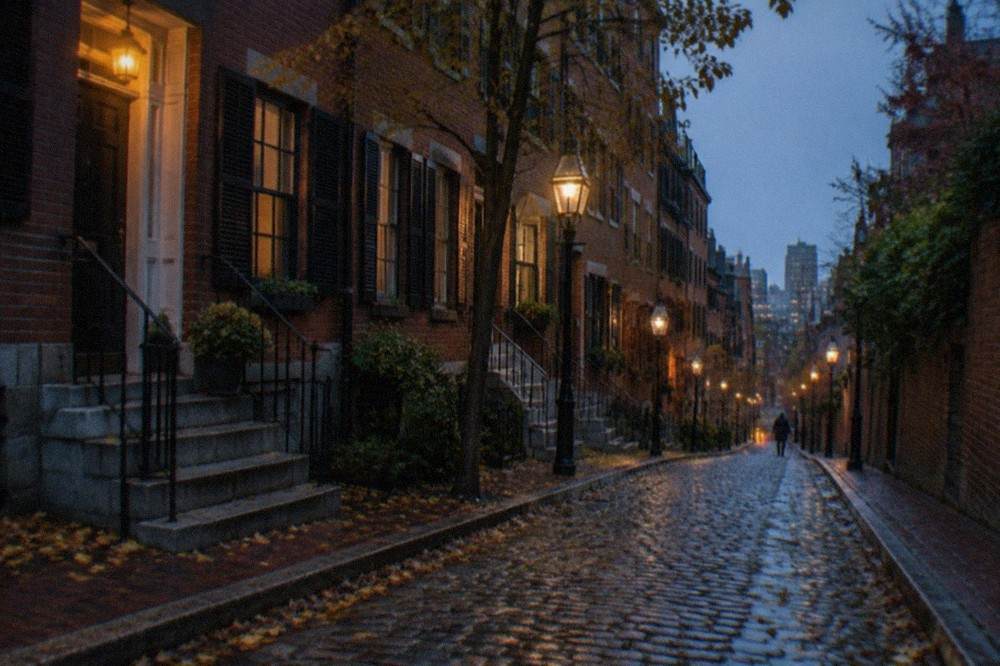
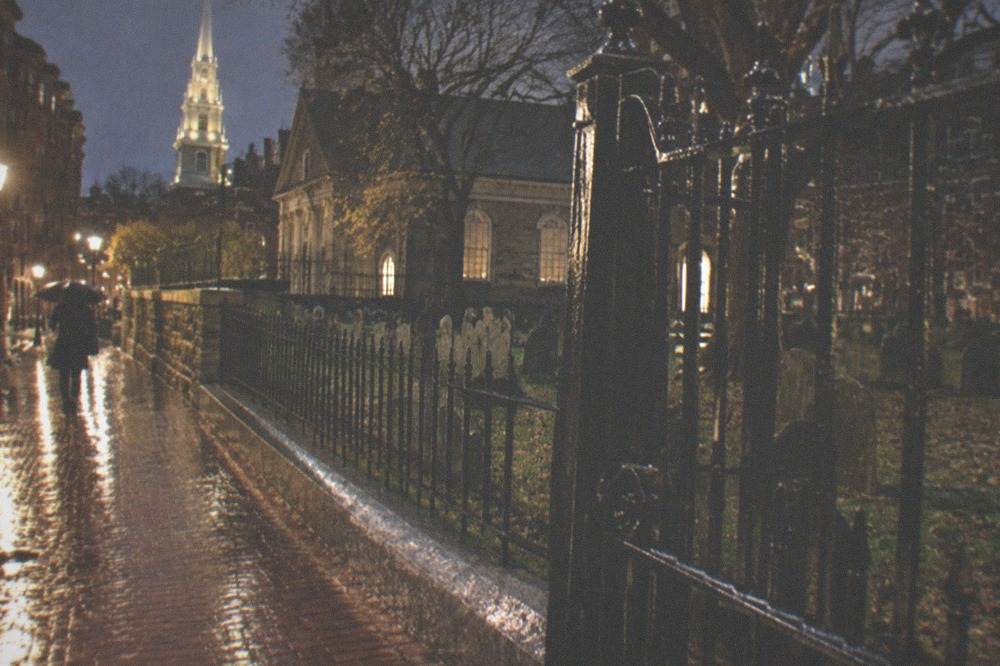
The walking format routes through the downtown burying grounds and Beacon Hill: the Death-And-Dying Theme Ghost Walk starts at the State House on Beacon Street, and Ghost City's 1.5-Hour Night-Time Ghost Walk starts at 58 Tremont Street outside King's Chapel Burying Ground. The trolley starts at Long Wharf on the waterfront and sweeps a wider loop. Both walk routes and the trolley overlap heavily on the same core sites.
The geographic anchor for both formats is the Freedom Trail, the official 2.5-mile route that the Freedom Trail Foundation describes as connecting 16 nationally significant historic sites. Ghost walks essentially run haunted versions of the trail's downtown half. The trail directory lists Boston Common, the State House, Park Street Church, Granary Burying Ground, King's Chapel and its burying ground, and further sites through the North End, and that is also the skeleton of the walking ghost-tour map.
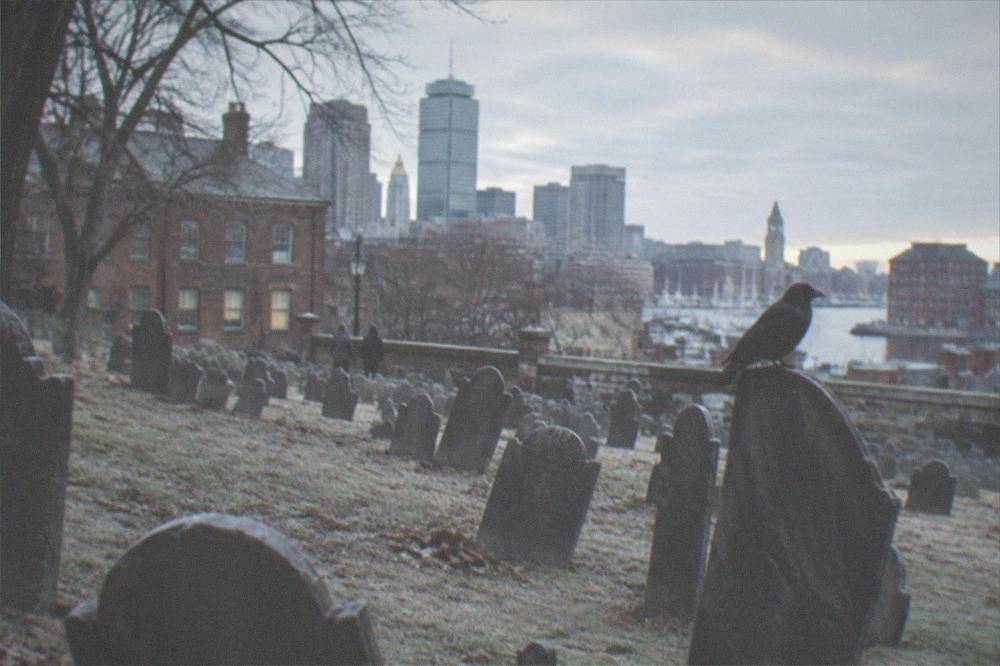
The burying grounds themselves carry the weight. Granary, established 1660, holds Samuel Adams, John Hancock, Robert Treat Paine, Paul Revere and the five Boston Massacre victims, per the City of Boston's own page for the site. King's Chapel Burying Ground, established 1630, is the city's oldest, with a 1985 survey counting 586 surviving markers over an estimated thousand-plus interments. These are the stops both formats trade on, the walk by standing in them, the trolley by visiting a selection.
| Product | Start point | Format of the route |
|---|---|---|
| Death-And-Dying Theme Ghost Walk | 24 Beacon St, State House | On-foot loop of downtown sites |
| 1.5-Hour Night-Time Ghost Walk | 58 Tremont St, King's Chapel | On-foot loop of downtown sites |
| 1-Hour Underground Ghost Walk | 139 Tremont St, Boston Common | Short on-foot loop |
| 2-Hour Ghosts and Gravestones Trolley | 200 Atlantic Ave, Long Wharf | Multi-neighborhood trolley loop with off-board stops |
Practically, this means the route question is not really "which sites" but "how you experience them." If standing at Paul Revere's grave at night is the draw, the walks win by construction. If seeing the widest slice of haunted Boston in one evening is the draw, the trolley's loop cannot be replicated on foot. The full index of guides sits on Boston Ghost Tours.
What About Weather, Distance And Accessibility?
The trolley is the weather-proof and mobility-friendly format: two hours mostly seated, from $46, with boarding at Long Wharf. The walking tours expose you to the elements for their full duration, though the 1-Hour Underground Ghost Walk, from $26, keeps its exposure to a single hour. Nothing on this roster is a wilderness hike; the walks are short, flat and paved.
Boston's autumn ghost season is also Boston's shoulder season, and the difference between formats sharpens exactly when demand peaks. A cold rain in late October is a minor inconvenience on the trolley and a genuinely miserable hour and a half on foot. The walks give you the burying grounds at night, which is the product, but they also give you whatever the sky is doing, for the entire runtime.
The distance itself is modest. The longest walking product on the roster is about a mile and a half; the themed walk and the underground hour are shorter. Downtown Boston is flat, and the routes stick to pavement. The constraint is duration on your feet, not terrain, which is why the accessibility question is really a stamina and temperature question.
The "1-Hour Underground Ghost Walk" is the roster's hedge against exactly this problem: one hour, from $26, rated 4.0 from 274 reviews, the cheapest one-hour walk on the site. It compresses the walking format to its smallest viable unit, which makes it the sensible pick when the weather forecast argues against a long stand-up evening but the group still wants the on-foot experience.
Which Format Should Families And Groups Pick?
Families with children under ten and mixed-mobility groups should default to the trolley, which seats everyone for two hours from $46 and stops the negotiation over walking pace. Families with engaged tweens and teens can take a walking tour; the themed Death-And-Dying walk suits older kids, while the 1-Hour Underground Ghost Walk suits younger ones. Note that the pub crawls are 21-plus and out of scope here.
The group dynamics differ sharply by format. On a walk, the guide holds a group together by voice and proximity, and a restless child is visible to everyone. On the trolley, the vehicle does that work: everyone is seated, the narration is amplified, and a child who wilts is a child in a seat rather than a child dragging a chain of twenty adults to a stop.
Age matters more than courage. The death-and-dying theme is a history-first framing, epidemics and burial customs, which lands well with ages ten and up but can be heavy for younger ones. The underground hour is lighter and shorter, a better fit for the six-to-nine range. And if the group's question is really "which of the five walks," that is a different page: the full ranking, with family-suitability notes, lives in our best ghost tours in Boston guide.
For adult groups, honestly, the format choice collapses back to the earlier criteria: price and depth favor the walk, coverage and comfort favor the trolley. A group of eight split evenly on the question should take the trolley, because the seated format tolerates a split group better than a walk tolerates two laggards.
The Verdict: When To Book Each Format
Book the Death-And-Dying Theme Ghost Walk when you want depth per stop, proximity to the graves, and the lower price, from $35 with 4.5 from 230 reviews. Book the 2-Hour Ghosts and Gravestones Trolley when you want coverage, comfort, weather protection and the most battle-tested product, from $46 with 4.5 from 2,645 reviews. They are different evenings, not different grades of the same one.
The honest summary is that this is not a quality contest. The trolley is the roster's heavyweight and the walks are its specialists, and the ratings gap, 4.5 against 4.5 at the top, says the market prices them as peers. The decision variable is what kind of evening you are designing: a close, quiet, site-anchored telling, or a wide, seated, greatest-hits sweep.
| Book the walk if... | Book the trolley if... |
|---|---|
| You want to stand inside the burying grounds at night | You want to cover multiple neighborhoods in two hours |
| Your budget caps near $35 | Two hours seated sounds better than 90 minutes standing |
| Your group can hold a walking pace | Weather, knees or energy argue against standing |
| You want a themed, history-first telling | You want the product with 2,645 reviews behind it |
One planning footnote that belongs to this verdict and nowhere else: the same logic that separates walk from trolley also separates ghost tour from crawl, and if your evening is really about drinks with stories attached, that is a third decision covered elsewhere on this site. This page's two products, the themed walk and the trolley, both carry free cancellation on their listings, so the cheapest strategic move in a Boston October is to book early and adjust if plans shift.
Common Questions About Walking Tours Versus Trolleys
Is A Ghost Walking Tour Or Trolley Better In Boston?
Neither is objectively better; they serve different evenings. The walks, from $22 to $35, deliver depth and proximity at the burying grounds. The 2-Hour Ghosts and Gravestones Trolley, from $46, delivers coverage, comfort and the most-tested product on the roster at 4.5 from 2,645 reviews. Pace and stamina decide it, not quality.
How Much More Does The Trolley Cost Than A Ghost Walk?
Eleven dollars at the representative comparison: the Death-And-Dying Theme Ghost Walk from $35 against the trolley from $46. Across the whole roster the gap widens to $24 at the extremes, from the $22 Common and Beacon Hill walk to the trolley's $46, but the walking product most comparable in theme sits close to the trolley on price.
Which Is Better In Bad Weather, The Walk Or The Trolley?
The trolley. Two hours mostly seated and sheltered beats ninety minutes on foot in Boston's autumn rain. If you still want the walking format in poor weather, the 1-Hour Underground Ghost Walk, from $26, compresses the exposure to a single hour.
Can You Cancel A Boston Ghost Tour If Plans Change?
Yes on every product in this comparison. The Death-And-Dying Theme Ghost Walk, the trolley and the underground walk all carry free cancellation on their listings. One walking tour on the roster, the 1.5-Mile Haunted Streets Walk, does not, so read its terms specifically if that is the one you are booking.
Do The Trolley And The Walking Tours Visit The Same Places?
Largely, yes. Both formats are built on the downtown core of the Freedom Trail, including Granary and King's Chapel Burying Grounds. The walks stand inside those sites for the duration; the trolley visits a selection of stops within a much wider loop that reaches neighborhoods a walk cannot cover.