Where Is Paul Revere Buried?
Paul Revere is buried in Granary Burying Ground on Tremont Street in Boston, a free, 9-to-4 cemetery stop on the Freedom Trail that most walking ghost tours pass or visit.
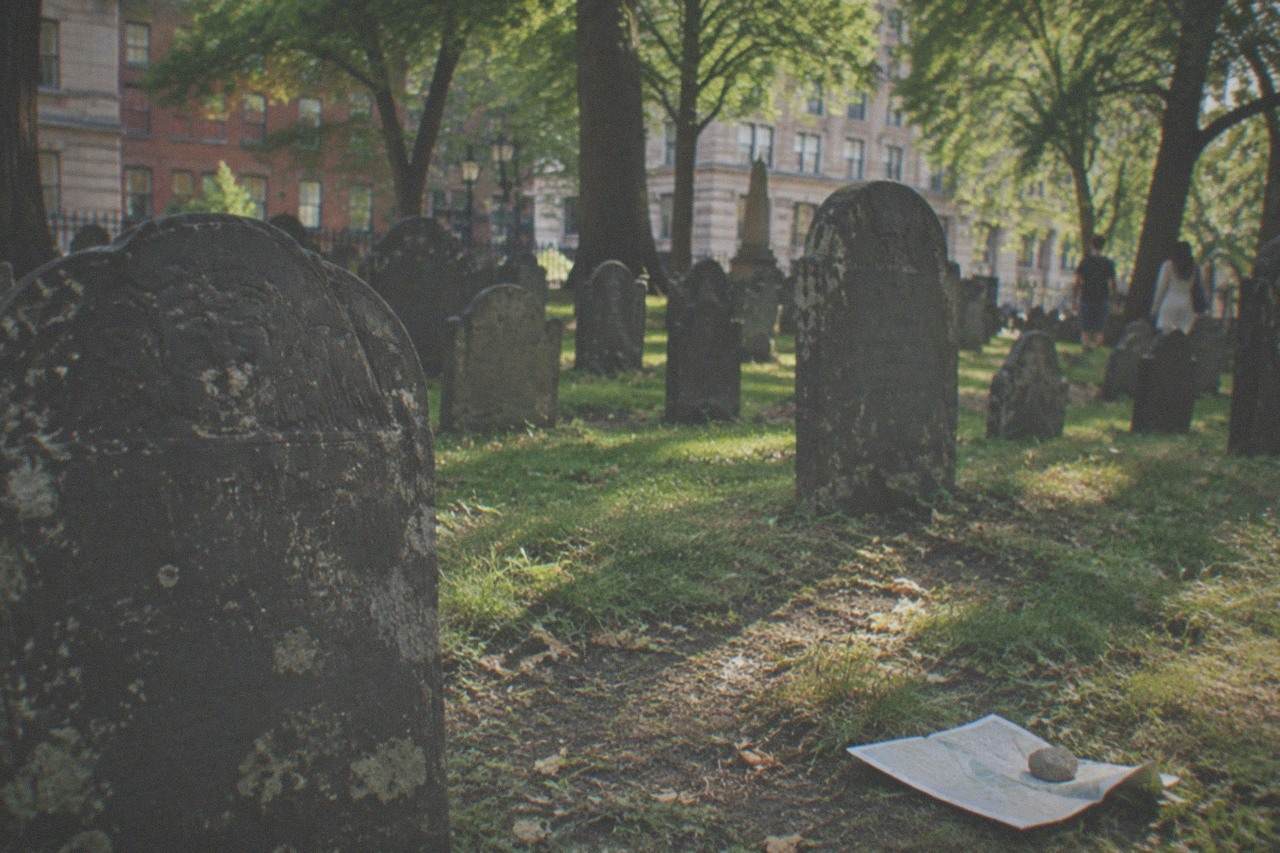
Most people looking for Paul Revere's grave are already standing within a few hundred yards of it. The midnight rider ended up exactly where you would expect a Boston artisan of his standing to end up: in the Granary Burying Ground on Tremont Street, wedged between the Boston Common and Park Street Church, in a cemetery he shares with two signers of the Declaration of Independence and the victims of the Boston Massacre. The city of Boston's own cemetery page confirms it, the Freedom Trail runs straight past the gate, and nearly every ghost walk in downtown Boston either enters the grounds or tells its stories within sight of the wall.
Where Is Paul Revere Buried?
Paul Revere is buried in the Granary Burying Ground at 120 Tremont Street in Boston, the city's third-oldest cemetery, established in 1660. His grave sits among roughly 2,345 surviving gravestones and tombs in a ground believed to hold more than 5,000 burials. Entry is free, the site is open daily from about 9 a.m. to 4 p.m., and it is an official stop on the Freedom Trail.
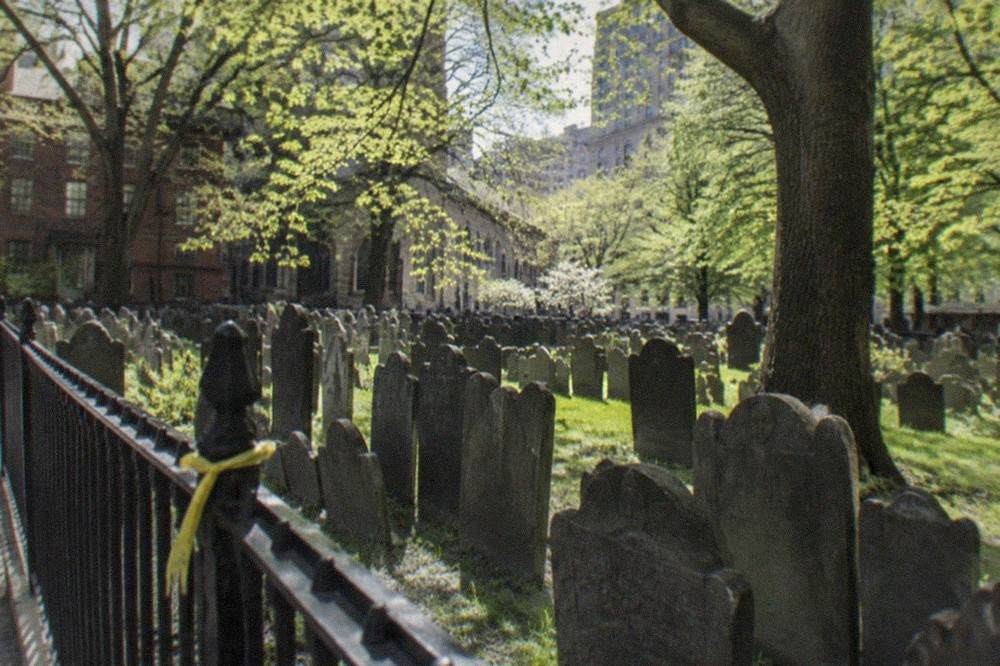
The Granary sits on the east side of Tremont Street between Park Street and School Street, directly across from the Boston Common. If you are standing on the Freedom Trail, you will hit it a few minutes after the State House and Park Street Church: the trail's red line runs along the cemetery fence and its official route counts the Granary among its 16 sites. The gate is unmistakable, a grand stone entrance added in the Victorian era, and Revere's marker is inside.
Finding the exact stone takes a moment. Revere's grave is marked by a relatively modest family headstone compared with the obelisks nearby. He is not far from the large central monument honoring the family of Benjamin Franklin, whose parents are also buried here, and from the markers of Samuel Adams and John Hancock. Many visitors walk right past the stone and have to double back; tours that stop here point it out specifically for exactly that reason.
One thing worth knowing before you go: the gravestones you see were rearranged into tidy rows in the 19th century for aesthetics and maintenance, so the neat lawn-and-rows layout is a Victorian reorganization, not the colonial jumble Revere would have known. The bodies stayed where they were. The stones moved. That detail alone makes the ground more interesting than it first appears, and it is one reason ghost guides like the stop.
If you are mapping a fuller haunted itinerary around downtown, the Freedom Trail ghost walk guide covers how the 2.5-mile trail doubles as a haunted route at night, with the Granary as its most atmospheric single stop.
Why Is Revere In The Granary And Not Somewhere Else?
Revere is buried in the Granary because it was the standard burying ground for downtown Bostonians of his era. The cemetery had been the city's workhorse since 1660, opened to relieve the badly overcrowded King's Chapel Burying Ground next door, and it absorbed generations of merchants, artisans, patriots, and paupers alike until burials largely ended by 1880.
The Granary began, per the city's records, as an overflow site for King's Chapel, which by 1660 had run out of room. It was initially known as the South or Common Burying Ground, sitting on land that was then the edge of Boston Common. The name came later, in 1737, borrowed from a granary building that once stood nearby on the site now occupied by Park Street Church.
By the Revolutionary period, the Granary was where central Boston buried its dead. That is why the patriot leadership clustered there: Samuel Adams, John Hancock, and Robert Treat Paine, all three signers of the Declaration, plus James Otis, Peter Faneuil of Faneuil Hall fame, and the five victims of the Boston Massacre, including Crispus Attucks. Revere, a working silversmith and foundryman who became a respected businessman after the war, fit the neighborhood perfectly. He had lived his whole life within a short walk of the ground.
There is a common misconception that Revere's grave is grand or that he was reburied somewhere ceremonial. It is not. The marker is a simple family stone, and the city's page for the ground makes no fuss about it beyond listing him among the notable burials. The modesty is part of the story: the man whose ride made him famous died prosperous but not monumentally so, and his grave reflects a Boston that still thought of him as a local craftsman who did one famous night's work.
What Else Is Buried In The Granary Burying Ground?
The Granary holds an unusual concentration of Revolutionary-era names: three signers of the Declaration of Independence, the Boston Massacre victims, Paul Revere, James Otis, Peter Faneuil, nine Massachusetts governors, and the parents of Benjamin Franklin. A central 25-foot obelisk marks the Franklin family plot. The city estimates more than 5,000 burials against roughly 2,345 visible stones and tombs.
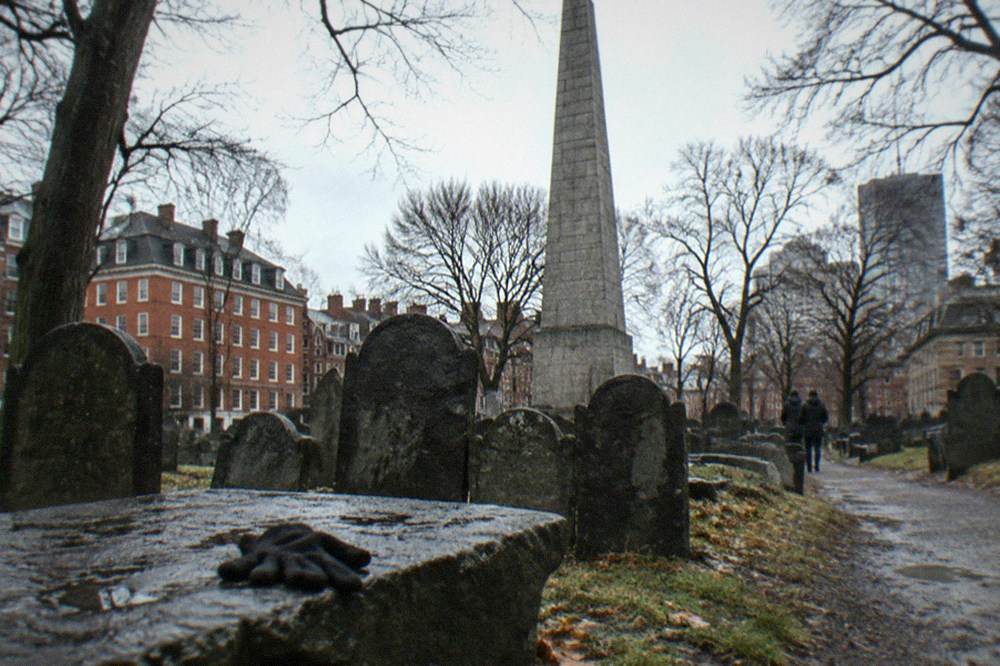
Because so many markers are missing or were never placed, the visible stones are only a fraction of the dead. Family crypts line the perimeter, and unmarked graves fill the interior. That gap between 2,345 stones and 5,000-plus burials is the statistic that haunts the ground: most of the people here, including children who died in the city's frequent epidemics, have no marker at all.
The names that do survive read like a walking tour of the Revolution:
| Burial | Marker and Notes |
|---|---|
| Paul Revere | Modest family headstone, steps from the Franklin obelisk |
| Samuel Adams | Declaration signer, governor; grave marked near the central path |
| John Hancock | Declaration signer; buried in a family tomb |
| Robert Treat Paine | Third Declaration signer in the ground |
| Boston Massacre victims | Five dead, including Crispus Attucks, buried together |
| James Otis | Patriot lawyer; subject of the Granary's most repeated ghost tale |
| Peter Faneuil | Merchant who funded Faneuil Hall |
| Franklin family | Benjamin Franklin's parents, marked by a 25-foot central obelisk |
| Mary Goose | Died around 1690; linked to the Mother Goose legend, which historians dispute |
The city maintains the ground under its Historic Burying Grounds Initiative, with a single Parks and Recreation contact number for all four colonial burying grounds. The official Granary Burying Ground page publishes the hours and the notable-burial list. Photography is welcome; gravestone rubbing is not, and the uneven paths are worth minding after rain.
If the age of this ground has you curious how it stacks up against the state's older sites, the companion piece on the oldest cemetery in Massachusetts traces the full lineage, and it is not the Granary: Boston's oldest burying ground dates to 1630, and it is a two-minute walk away.
How Do You Visit The Granary, And When Should You Go?
The Granary Burying Ground is free to enter and open daily from about 9 a.m. to 4 p.m., at 120 Tremont Street between Park Street and School Street. The nearest T stops are Park Street on the Red and Green Lines and Government Center on the Blue Line, both under ten minutes on foot. Hours can tighten in winter, so the city's cemetery page is the place to confirm before an early-morning or late-afternoon visit.
The ground is small enough to see in twenty minutes at a stroll, but the rewarding way to do it is slower. The slate stones carry the classic New England carving progression, from grim death's heads on the oldest markers to winged cherubs and, later, urns and willows, a visual record of how colonial Boston's ideas about death softened over the colonial era. Go in the morning and you often share the paths with only a few Freedom Trail walkers; by mid-afternoon school groups and tour clusters fill the central lane.
Evening is a different matter entirely, and that is where the after-dark products come in. The "1-Hour Underground Ghost Walk" meets at 139 Tremont Street, at the Boston Common Visitors Center across from the Dunkin', a few hundred yards from the Granary gate, and runs from $26 with a 4.0 rating across 274 reviews. It is the cheapest tour on the roster and a good fit if you want the burying-ground stories without committing a full evening.
For most visitors the choice is not whether to see the Granary but in what light. Daytime gives you the history straight and readable; night gives you the version the guides tell, when the death's heads on the oldest stones are harder to dismiss as decoration. Doing both, a daytime walk on your own and a guided evening walk, is the pattern that the itineraries on this site keep coming back to.
Which Ghost Tours Actually Stop At The Revere Grave?
Yes, several bookable tours visit or pass the Granary. The "2-Hour Ghosts and Gravestones Trolley" is the most-reviewed product on the roster, 4.5 across 2,645 reviews from $46, and its route is the one most associated with burying-ground access. Among walking tours, the most-reviewed option is the "1.5-Hour Night-Time Ghost Walk", 4.5 from 313 reviews from $30, meeting outside King's Chapel Burying Ground one block north of the grave.
Meeting points tell you a lot about route geography. The "Common And Beacon Hill Route" from Tours by Foot meets at the Boylston Street subway station, corner of Boylston and Tremont, which puts you at the foot of the Common with the Granary a short walk up Tremont. It runs about 1.5 hours from $22 and holds a 5.0 rating, though from a small pool of 12 reviews, so read it as a well-liked niche option rather than a proven volume seller. The "1.5-Mile Haunted Streets Walk" from ExperienceFirst meets at the Robert Gould Shaw and 54th Regiment Memorial on the Common, covers about 1.5 miles in the same amount of time, and runs from $34 with a 5.0 from 49 reviews; note that this one listing is the only roster tour without free cancellation, so it is the one to book only when your plans are firm.
The comparison in plain terms:
| Tour (decision name) | Duration | Price | Rating | Meeting Point Relative to the Granary |
|---|---|---|---|---|
| 2-Hour Ghosts and Gravestones Trolley | 2 hours | From $46 | 4.5 across 2,645 reviews | Long Wharf, Old Town Trolley stop #1 |
| 1.5-Hour Night-Time Ghost Walk | 1.5 hours | From $30 | 4.5 across 313 reviews | 58 Tremont St, outside King's Chapel Burying Ground |
| Common And Beacon Hill Route | 1.5 hours | From $22 | 5.0 across 12 reviews | Boylston St Subway Station, corner of Boylston and Tremont |
| 1.5-Mile Haunted Streets Walk | 1.5 hours, ~1.5 miles | From $34 | 5.0 across 49 reviews | Shaw/54th Regiment Memorial, Boston Common |
| 1-Hour Underground Ghost Walk | 1 hour | From $26 | 4.0 across 274 reviews | 139 Tremont St, Boston Common Visitors Center |
The "Death-And-Dying Theme Ghost Walk" is also worth a mention for this specific question: it meets at 24 Beacon Street in front of the Massachusetts State House, which sits at the top of the Common with the Granary below it on Tremont, and it runs from $35 with a 4.5 from 230 reviews. Its duration is not published on the roster, so check the live listing before booking. Themed around funeral practices and mortality rather than pure ghost stories, it is the tour whose whole concept leans on the burying grounds.
Whichever you pick, the practical advice is the same: confirm the meeting point on the live listing the day of, since Tremont Street has several similarly described corners, and arrive ten minutes early. Park Street, King's Chapel, the Visitors Center, and the Shaw Memorial are all within a quarter mile of each other, and missing a tour because you stood at the wrong burying-ground gate is a genuinely common mistake in this neighborhood.
The Common And Beacon Hill Route is the one this site most often pairs with a Granary-focused evening, and free cancellation applies to its listing.
What Are The Ghost Stories At The Granary?
The Granary's most repeated tale concerns James Otis Jr., the patriot lawyer who was struck by lightning after years of mental decline, and whose ghost is described in tour lore as a tall figure in colonial dress. Guides and paranormal blogs also report orbs, shadows, and figures among the stones. All of this is storytelling tradition, not documented history; the verified record covers who is buried here, not who haunts it.
The Otis story is the one guides return to, and the historical core of it is real even if the ghost is not. Otis, who famously argued against the writs of assistance in the popular telling, deteriorated mentally in his later years and was killed by lightning. His death was the kind of event a Puritan-descended city could not help reading as commentary, and the burying ground got the reputation that came with it.
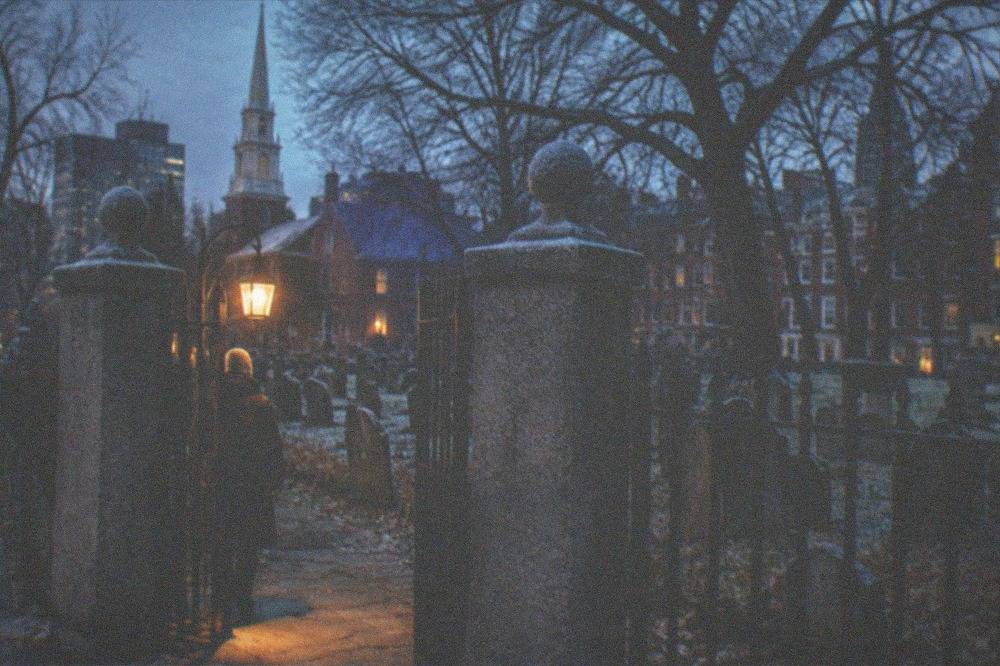
The rest of the ground's haunted reputation is atmospheric rather than event-based. The stones are dark slate, the paths are narrow, the death's-head carvings stare blankly, and at night the Park Street Church spire looms over the wall. One widely retold incident involves a visitor who reportedly fell into a previously hidden crypt opening, a reminder that under the neat lawn there are real tombs the Victorian rearrangement never touched. That combination, documented density of graves plus genuine hidden voids, is what keeps the Granary on every downtown route.
Mary Goose adds the strangest footnote. A woman named Mary Goose, who died around 1690, is buried here, and local tradition long tied her to the Mother Goose nursery rhymes. Historians trace the Mother Goose archetype elsewhere and find no direct evidence linking this Mary Goose to the published tales, but the legend is still told at the gate, and the grave still gets visitors because of it. Treat it the way the guides do when they are being honest: a good story attached to a real grave.
What About King's Chapel Burying Ground Next Door?
King's Chapel Burying Ground, one block north at Tremont between School and Park Streets, is Boston's oldest cemetery, established in 1630 at the founding of the town. It holds first governor John Winthrop, Mayflower passenger Mary Chilton, and Elizabeth Pain, whose stone is sometimes cited as a possible inspiration for Hester Prynne in The Scarlet Letter. A 1985 survey counted 586 markers, and researchers believe more than 1,000 people lie there.
King's Chapel Burying Ground was Boston's only burial site until around 1660, which is why the Granary exists at all. Overcrowding there forced multi-body and shallow graves, and most interments had ceased by 1796. The ground predates the adjacent King's Chapel church, built in 1688, and has never been under church control; it has always belonged to the town, now the city.
Its ghost stories are, like the Granary's, lore rather than record: a headless woman, a man said to have been buried alive with a bell-string in one variant of the tale, and restless spirits blamed on the 19th-century rearrangement that moved stones without always moving bodies. The rearrangement detail is historically documented, and it is the fact that gives the folklore its foothold. Ghost City Tours' night walk meets directly outside this ground, which is why the King's Chapel stories surface so often in reviews of that tour.
For a visitor sequencing the two, the honest ranking is: see the Granary first for Revere and the Revolution names, then walk one block north to King's Chapel for the deeper age. One entrance faces the other along Tremont; together they compress centuries of Boston's dead into about 300 yards of sidewalk. The city's King's Chapel page publishes the same daily hours, roughly 9 a.m. to 4 p.m.
How Does The Grave Fit Into A Full Freedom Trail Day?
The Granary is the third or fourth site most walkers reach on the Freedom Trail's 2.5-mile, 16-site route, coming after Boston Common, the State House, and Park Street Church. The Freedom Trail Foundation's most popular guided tour covers 11 of the 16 sites, and the trail's official directory lists the Granary among its signature stops. A walker starting at the Common reaches the gate in about ten minutes.
The trail's own materials describe it plainly: a 2.5-mile line connecting 16 nationally significant historic sites, red-bricked or painted through downtown. Coming from the Common, the sequence runs Boston Common, State House, Park Street Church, then the Granary, then King's Chapel, the Old Corner Bookstore, the Old South Meeting House, and the Old State House, continuing toward the North End, where Copp's Hill Burying Ground, another haunted stop in the storytelling tradition, and the USS Constitution finish the route at Bunker Hill.
That geography is why the burying-ground cluster anchors so many itineraries on this site. The official trail site directory gives the full list for planning, and a ghost-oriented reading of the trail is exactly what the Freedom Trail ghost walk article lays out stop by stop, from the hanging ground of the old Common to the Massacre site on State Street.
A practical half-day built around the grave: start on the Common in the morning, walk the trail's downtown stretch past the State House to the Granary while the light is good for reading slate, continue through King's Chapel and the Old State House, then break in the North End. Come back for an evening walk, since the same ground that reads as pure history at noon is the entire stage set of the ghost tours after dark. For readers weighing that evening choice across the whole roster, Boston Ghost Tours keeps a current comparison of the walking, trolley, and pub-crawl options, with prices and review counts from the live listings.
Budget the burying grounds honestly: the Granary itself is free, but the guided tours that animate it run from $22 to $46 depending on format, and the fuller breakdown of what each format costs sits in the site's cost guide for those planning a multi-tour night.
Common Questions About Paul Revere's Grave
Where Is Paul Revere Actually Buried?
Paul Revere is buried in the Granary Burying Ground at 120 Tremont Street in Boston, established in 1660. His grave lies among roughly 2,345 surviving markers in a ground estimated to hold more than 5,000 burials, alongside Samuel Adams, John Hancock, and the Boston Massacre victims. The site is free and open daily from about 9 a.m. to 4 p.m.
Where Is Paul Revere's Grave?
His grave is inside the Granary Burying Ground on Tremont Street, marked by a modest family headstone, not far from the 25-foot Franklin family obelisk at the center of the ground. The marker is easy to walk past; several guided tours point it out for that reason.
Is The Granary Burying Ground Free To Visit?
Yes. The Granary is a city-owned historic burying ground with free entry and no tickets required. It is generally open daily from about 9 a.m. to 4 p.m., though hours can vary slightly with the season, so the city's cemetery page is the source to confirm before an early or late visit.
Which Ghost Tours Stop At The Granary?
Multiple walking tours pass or visit the Granary because it sits on the Freedom Trail. The most-reviewed walking option is the "1.5-Hour Night-Time Ghost Walk" from Ghost City Tours, 4.5 from 313 reviews, from $30, meeting one block north at King's Chapel Burying Ground. The "2-Hour Ghosts and Gravestones Trolley" is the roster's most-reviewed product at 4.5 across 2,645 reviews, from $46.
Is Paul Revere Buried Near The Boston Massacre Victims?
Yes, in the same burying ground. The five victims of the Boston Massacre, including Crispus Attucks, are buried in the Granary, as are Samuel Adams, John Hancock, and Robert Treat Paine. The concentration of Revolutionary names within one small ground is unusual and is the reason so many tours route through Tremont Street.
What Is The Oldest Cemetery In Boston?
King's Chapel Burying Ground, established in 1630 at the town's founding, is Boston's oldest. The Granary, dating to 1660, is the third-oldest, created as overflow when King's Chapel ran out of room. The two face each other along Tremont Street one block apart.