What's The Oldest Cemetery In Massachusetts?
Discover the oldest cemetery in Massachusetts, King's Chapel Burying Ground in Boston, established in 1630. Learn about its history, notable burials, and how to visit on a ghost tour.
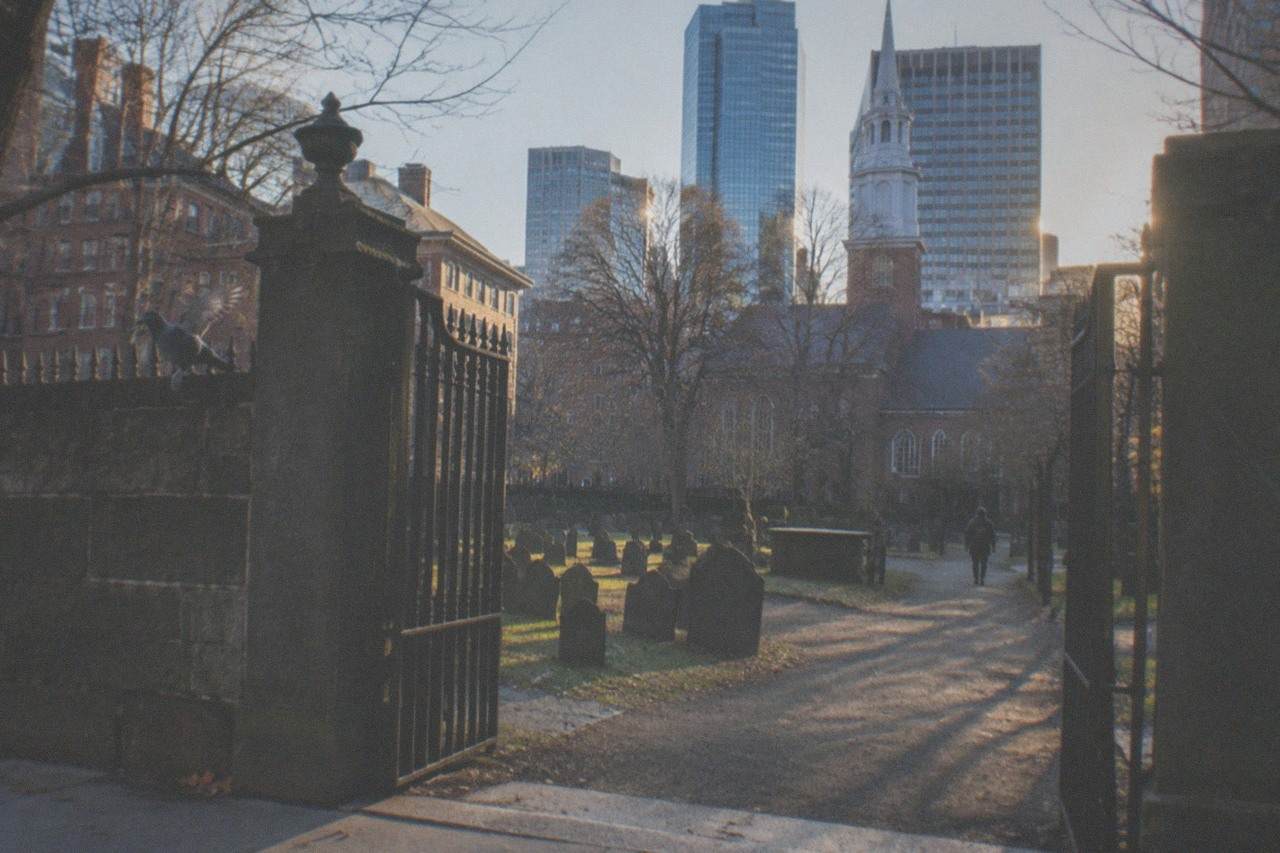
King's Chapel Burying Ground, a small patch of weathered stone and tilted slate just off Tremont Street, is the oldest cemetery in Massachusetts. The site was set aside as a burial place in 1630, the same year Boston itself was founded, and it remained the city's only graveyard for the next three decades. Today it sits squarely on the Freedom Trail, a stop on nearly every walking ghost tour that crisscrosses downtown, and a visit here is one of the simplest ways to stand inside the oldest surviving piece of the city's physical record. For anyone researching Boston Ghost Tours, the burying ground is the foundational landmark: the first burial, the first headstone, the first recorded death in a settlement that would become a colonial capital.
What's The Oldest Cemetery In Massachusetts?
King's Chapel Burying Ground in downtown Boston, established in 1630, is the oldest cemetery in Massachusetts. It sits on Tremont Street between School and Park Streets, directly on the Freedom Trail, and is the final resting place of Mayflower passenger Mary Chilton and Massachusetts' first governor John Winthrop. The City of Boston maintains the site, which is open daily from about 9 a.m. to 4 p.m. and is free to walk through.
The burying ground predates the adjacent King's Chapel church itself, which was not built until 1688. In its first decades, the site was simply called the Burying Place or the Old Burying Ground, and it absorbed the dead of a rapidly growing Puritan settlement. Because it was the only cemetery in town until Granary Burying Ground opened in 1660, the ground filled quickly, with bodies layered in shallow graves and stacked in family tombs. A 1985 survey counted 586 visible grave markers, but researchers now believe more than 1,000 people are interred there, many in unmarked plots that predate the surviving headstones. The stones that remain were rearranged in the 19th century into neat rows for aesthetics and easier maintenance, so the current layout does not always align with the original burials.
Visitors walking the Freedom Trail often step through the iron gate without realizing they are walking over a site that was already old when the Salem witch trials began in 1692. The burying ground's age is its central claim: 1630 makes it older than any other documented cemetery in Massachusetts, and older than most burial sites in the original thirteen colonies. The City of Boston's Historic Burying Grounds Initiative manages the property, and the official page on boston.gov confirms the founding year and the daily hours. No tickets are required, and the gate is open to anyone who wants to read the fading inscriptions on the slate markers.
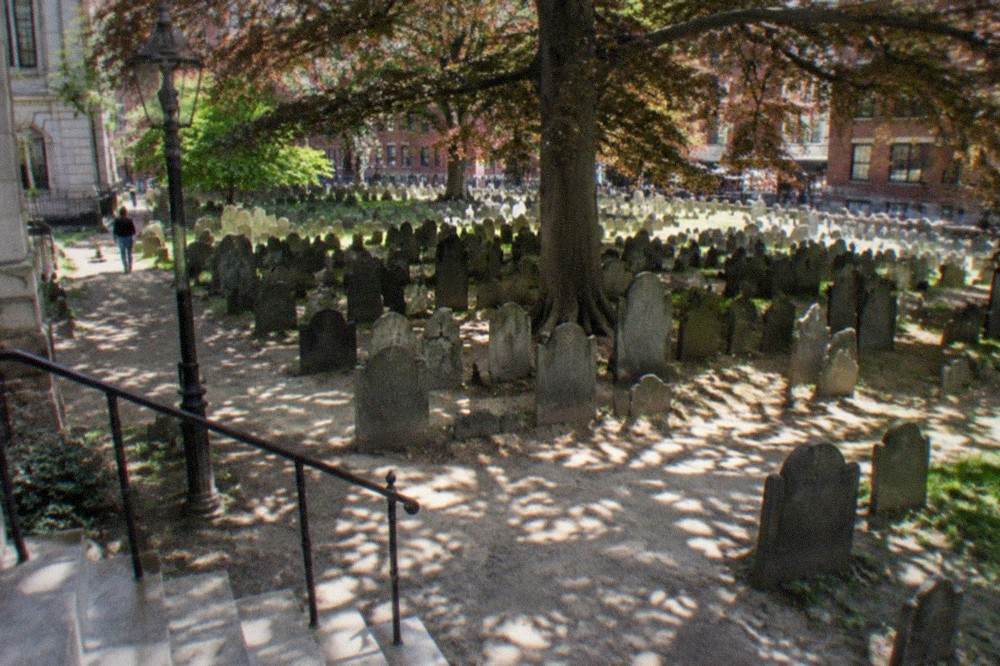
The burying ground's connection to Boston's ghost tour scene is direct and practical. Several walking tours stop at the gate and use the headstones as a backdrop for stories about early Boston deaths, Puritan burial customs, and the folklore that has grown up around the site. The oldest cemetery in Massachusetts is also one of the most accessible: it sits in the heart of downtown, a block from the Park Street T station, and takes only fifteen or twenty minutes to walk through slowly. For a visitor trying to decide which ghost tour to book, a tour that includes King's Chapel Burying Ground is a tour that starts with the oldest physical evidence of the city's past.
Why King's Chapel Burying Ground Is Considered The Oldest
The claim rests on a documented founding date of 1630, the same year the Massachusetts Bay Colony established Boston. No other cemetery in Massachusetts has a verified earlier date. The City of Boston's own records, the Freedom Trail Foundation, and multiple historical surveys all point to King's Chapel as the first burial ground in the colony, predating Granary Burying Ground (1660), Copp's Hill (mid-17th century), and Central Burying Ground (1756) by decades.
The 1630 date is not a legend or a tour-guide invention. It comes straight from the city's own burying-ground records, which makes King's Chapel Burying Ground the oldest cemetery in Massachusetts. It comes from the city's own records, which note that the land was set aside as a common burying place immediately after the settlement was laid out. The first recorded burial is traditionally attributed to Isaac Johnson, an early settler who died in 1630 and was interred on the spot. Over the next thirty years, the ground filled with the colony's dead: Puritan ministers, merchants, sailors, and victims of the smallpox outbreaks that swept through Boston in the 17th century. By the time Granary Burying Ground was opened in 1660 to relieve overcrowding, King's Chapel had already been the sole burying site for an entire generation.
Other cemeteries in Massachusetts sometimes claim older origins, but none can produce a primary source that predates 1630. The Plymouth Colony had burial sites, but none were formally established as a cemetery with a recorded founding date that early. The Myles Standish Burial Ground in Duxbury, for example, contains graves from the 1630s, but the site itself was not designated as a cemetery until later. King's Chapel Burying Ground is the oldest because it was the first to be set aside for that purpose by the governing authority of the colony, and the documentation survives.
| Cemetery | Location | Established | Notable Feature |
|---|---|---|---|
| King's Chapel Burying Ground | Tremont Street, Boston | 1630 | Oldest in Massachusetts; burial of John Winthrop and Mary Chilton |
| Copp's Hill Burying Ground | North End, Boston | Mid-17th century | Second oldest in Boston; British soldiers from Bunker Hill |
| Granary Burying Ground | Tremont Street, Boston | 1660 | Third oldest; Paul Revere, Samuel Adams, Boston Massacre victims |
| Central Burying Ground | Boston Common | 1756 | Fourth oldest; Gilbert Stuart, subway construction disturbance |
The table above shows the four oldest burying grounds in Boston, all of which are stops on various ghost tours. King's Chapel is the clear outlier in age, established decades before the others. The gap is significant because it means the cemetery absorbed the dead from the earliest, hardest years of the colony, when mortality rates were high and burial records were sparse. Many of the unmarked graves at King's Chapel date from this period.
Other Early Boston Cemeteries That Ghost Tours Visit
Boston has four historic burying grounds that appear on ghost tour routes, all established before the Revolutionary War. King's Chapel is the oldest, but Granary Burying Ground (1660), Copp's Hill Burying Ground (mid-17th century), and Central Burying Ground (1756) each hold their own place in the city's haunted history, with Granary being the most visited because of its famous Revolutionary-era burials.
Granary Burying Ground, located just a block from King's Chapel on Tremont Street, is the one most visitors picture when they think of a historic Boston cemetery. It holds the graves of Paul Revere, Samuel Adams, John Hancock, and the five victims of the Boston Massacre, including Crispus Attucks. An estimated 5,000 people are buried there, though only about 2,345 gravestones and tombs are visible. Granary is the third-oldest cemetery in Boston, and its proximity to King's Chapel means many walking tours cover both in a single outing. The City of Boston's Granary Burying Ground page confirms the founding date and the roster of notable interments.
Copp's Hill Burying Ground in the North End is the second oldest cemetery in the city. It sits on a hill overlooking the harbor and contains the graves of many British soldiers who died during the occupation of Boston, as well as prominent colonial figures like Increase and Cotton Mather. The site is less crowded than Granary or King's Chapel, and some ghost tours include it as a quieter stop with views of the water. Central Burying Ground on Boston Common is the youngest of the four, opened in 1756 to handle overflow from the older cemeteries. It holds an estimated 5,000 burials but far fewer visible markers, and it is known among ghost tour guides for the 1895 subway construction disturbance that unearthed hundreds of remains, which were reinterred in a mass grave on the site.
The Haunted Streets Walking Tour, a 1.5-mile route through the downtown area, may include burying-ground stops among its other historic sites; check the live listing for the current route. The tour is rated 5.0 from 49 reviews on the live listing and starts from $34 per person. It covers about 1.5 miles in 1.5 hours and meets at the Robert Gould Shaw and the 54th Regiment Memorial on Boston Common. Because it is a walking tour, the pace allows time to stop at the gates of King's Chapel and Granary and hear the stories that connect the headstones to the city's ghost lore.
For visitors who want a tour that specifically includes the oldest cemetery, the Haunted Streets route is a direct match, but it is not the only option. The Common and Beacon Hill route from Tours by Foot also covers the burying grounds, and the Underground Boston Ghost Walk from US Ghost Adventures takes a different angle, focusing on the darker history beneath the streets. Each tour approaches the cemeteries from a different narrative angle, so the choice depends on whether the visitor wants a broad history walk, a focused ghost story experience, or a budget-friendly option.
How To Visit King's Chapel Burying Ground On A Ghost Tour
The simplest way to visit the oldest cemetery in Massachusetts on a guided tour is to book a walking ghost tour that includes the Freedom Trail stops. Many downtown walking tours pass the burying ground, and some may include it as a formal stop; check the live listing for details. The site is also open to the public daily from about 9 a.m. to 4 p.m. for self-guided visits, with no ticket required.
Walking ghost tours that cover the downtown core almost always include King's Chapel Burying Ground because it sits directly on the Freedom Trail route between the Massachusetts State House and the Old City Hall. Several downtown walking tours, including the 1.5-mile Haunted Streets Walk from ExperienceFirst and the Common and Beacon Hill route from Tours by Foot, may pass by King's Chapel Burying Ground; check the live listing for the current itinerary, though the depth of coverage varies. Some tours use the burying ground as a backdrop for stories about early Boston deaths, including the Haunted Streets Walk and the Underground Walk, both of which pass through the area as part of their routes.
Self-guided visitors can simply walk through the iron gate on Tremont Street during daylight hours. The site is compact, roughly the size of a small city park, and the headstones are arranged in rows that make it easy to read the inscriptions. A printed guide or a mobile map can help identify the notable graves, but the city does not provide on-site interpreters. The Freedom Trail's official site lists King's Chapel Burying Ground as one of the 16 official stops, and the trail's red brick line leads directly past the entrance.
For visitors who want the oldest cemetery experience but prefer a self-guided approach, a morning walk through the burying ground followed by an afternoon ghost tour that covers Granary and Copp's Hill can create a full day of cemetery history. The burying grounds are all within walking distance of each other, and the Freedom Trail connects them in a logical loop. The Freedom Trail ghost walking tour guide on this site covers the full route in detail, including which tours stop at each burying ground.
What You'll See At King's Chapel Burying Ground
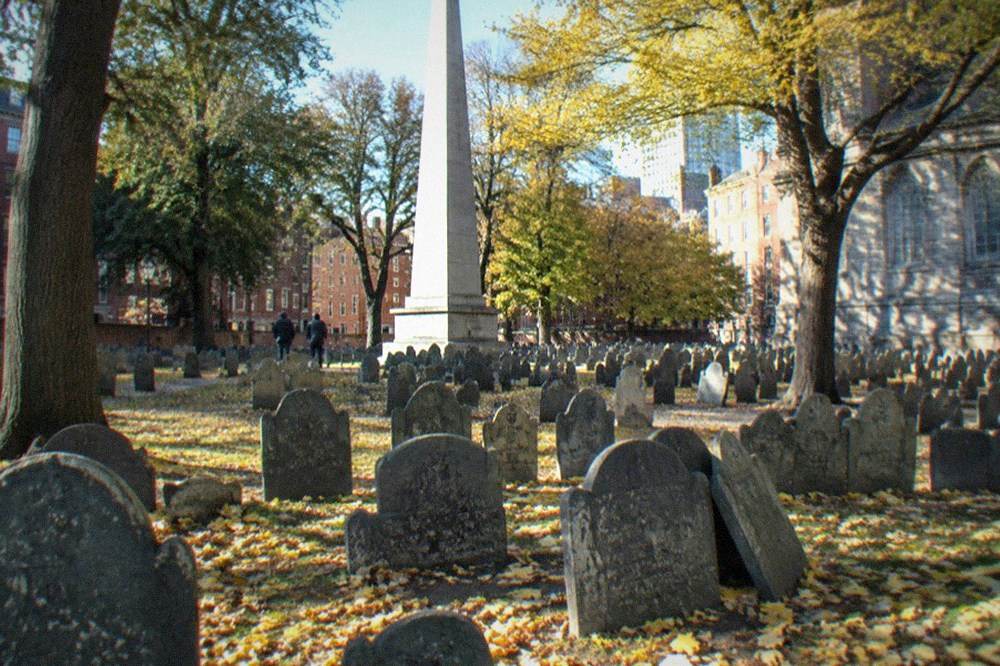
Visitors walking through the oldest cemetery in Massachusetts will see rows of slate headstones carved with death's heads, cherubs, and urn-and-willow motifs, along with a few above-ground tombs. The most notable graves include those of John Winthrop, Mary Chilton, and Elizabeth Pain, whose headstone is sometimes linked to the inspiration for Hester Prynne in Nathaniel Hawthorne's "The Scarlet Letter."
The visual character of King's Chapel Burying Ground is distinct from the other historic cemeteries in Boston. The headstones are older on average, with many dating from the colonial era, and the carvings reflect the evolution of New England funerary art from stark death's heads to softer cherub faces. The stone is mostly slate, which weathers to a dark gray and holds inscriptions well, though some have become illegible over three centuries of New England winters. A few table tombs and box tombs are scattered among the rows, and the perimeter walls contain family crypts that are no longer accessible.
The grave of John Winthrop, the first governor of Massachusetts, is marked by a simple slate stone near the center of the ground. Mary Chilton, who tradition holds was the first woman to step off the Mayflower, is also buried here, though her exact grave location is uncertain. Elizabeth Pain's headstone, dated 1704, is one of the most photographed in the cemetery because of its carved shield and the local legend that Hawthorne used it as the model for Hester Prynne's grave in "The Scarlet Letter." The story is unverified, but the association has made the stone a popular stop on ghost tours and history walks alike.
| Burial | Role | Grave Marker Notes |
|---|---|---|
| John Winthrop | First governor of Massachusetts | Simple slate stone, central location |
| Mary Chilton | Mayflower passenger | Exact grave uncertain, memorial noted |
| Elizabeth Pain | Died 1704 | Carved shield, linked to "The Scarlet Letter" folklore |
| William Dawes | Paul Revere's midnight ride compatriot | Marker present, remains later moved |
| Hezekiah Usher | Colonies' first printer and publisher | Early slate stone |
The burying ground's atmosphere is quieter than Granary's, partly because it receives fewer visitors and partly because the surrounding buildings block much of the street noise. The site is enclosed by an iron fence and shaded by a few trees, and the headstones are packed closely together, which creates a sense of density that matches the historical reality of overcrowded burials. Ghost tour guides often point out that the stones were moved in the 19th century, so the ground beneath a given marker may not hold the person named on it, a detail that adds to the site's haunted reputation in local folklore.
The Oldest Cemetery In Massachusetts Versus Other Historic Burial Grounds
King's Chapel Burying Ground is the oldest, but it is not the largest or the most visited. Granary Burying Ground draws more tourists because of its Revolutionary-era celebrities, while Copp's Hill offers harbor views and Central Burying Ground has a quieter, more neglected feel. Each cemetery serves a different purpose on a ghost tour itinerary, and understanding the differences helps a visitor decide which tours to book.
Granary Burying Ground, established in 1660, is the one that appears on postcards and in guidebooks. It holds the graves of three signers of the Declaration of Independence and the victims of the Boston Massacre, and its central obelisk marking the grave of Benjamin Franklin's parents is one of the most photographed monuments in the city. Granary is the third-oldest cemetery in Boston, but it is the most famous, and most walking tours spend more time there than at King's Chapel. The City of Boston's page on Granary lists the full roster of notable burials.
Copp's Hill Burying Ground, the second oldest, is located in the North End and offers a different perspective. It sits on a hill that overlooks the harbor, and during the British occupation of Boston, soldiers used the headstones for target practice, a detail that ghost tour guides often mention. The site contains the graves of the Mather family, prominent Puritan ministers, and many British soldiers who died during the war. It is less crowded than Granary and King's Chapel, and some tours include it as a quieter, more atmospheric stop.
Central Burying Ground, the youngest of the four at 1756, is the least visited. It sits on the edge of Boston Common and holds an estimated 5,000 burials but only a few hundred visible markers. The site is known for the 1895 subway construction disturbance, when workers uncovered hundreds of remains along Boylston Street. Those remains were reinterred in a mass grave on the northwest side of the burying ground, marked by a slate tablet. The story of the disturbance is a staple of ghost tour narratives, and the site's association with the Green Line subway ghosts makes it a popular stop on tours that focus on urban legends.
For a visitor trying to choose a ghost tour, the cemetery coverage is a useful filter. A tour that includes King's Chapel and Granary covers the oldest and the most famous, while a tour that adds Copp's Hill or Central Burying Ground offers a broader picture of the city's burial history. The Haunted Streets Walking Tour, the Underground Boston Ghost Walk, and the Common and Beacon Hill route may each cover different combinations of these sites; check the live listing for the current route, and the choice comes down to whether the visitor wants a broad history walk or a focused ghost story experience.
Common Questions About Boston's Oldest Cemeteries
What's The Oldest Cemetery In Massachusetts?
King's Chapel Burying Ground in Boston, established in 1630, is the oldest cemetery in Massachusetts. It is located on Tremont Street along the Freedom Trail and is open daily from about 9 a.m. to 4 p.m., free of charge. The site contains the graves of John Winthrop, Mary Chilton, and other early settlers.
What Is The Oldest Graveyard In Boston?
King's Chapel Burying Ground is the oldest graveyard in Boston, founded in 1630. It predates Copp's Hill Burying Ground (mid-17th century), Granary Burying Ground (1660), and Central Burying Ground (1756). The site is managed by the City of Boston and is a stop on the Freedom Trail.
Where Is Paul Revere Actually Buried?
Paul Revere is buried in Granary Burying Ground on Tremont Street in Boston, not in King's Chapel Burying Ground. His grave is marked by a prominent stone near the center of the cemetery and is one of the most visited graves in the city. For more detail, see our article on where Paul Revere is buried.
Are All The Historic Boston Cemeteries Free To Visit?
Yes, all four of Boston's historic burying grounds managed by the City of Boston are free and open to the public daily from about 9 a.m. to 4 p.m. No tickets are required, and visitors are welcome to walk through during daylight hours. The sites are part of the Historic Burying Grounds Initiative.
Can You Visit King's Chapel Burying Ground At Night On A Ghost Tour?
Most ghost tours that include King's Chapel Burying Ground stop at the gate and tell stories from the sidewalk, as the cemetery itself closes around 4 p.m. Some tours may visit after dark by special arrangement, but the standard experience is an exterior stop with the headstones visible through the iron fence.